Essential Ingredients and Preparation Tips
Success in sponge cake baking hinges on the quality and temperature of your ingredients, as well as meticulous preparation.
- Eggs: Use large eggs at room temperature. Cold eggs will not whip up to the required volume. Separate the whites and yolks carefully; any trace of fat in the whites will prevent them from reaching stiff peaks.
- Flour: All-purpose flour is fine, but sifting it (and any baking powder) at least twice is crucial. This aerates the flour, prevents lumps, and makes it easier to fold into the delicate egg mixture without deflating the batter.
- Vanilla: Use a good quality pure vanilla extract—the flavor really shines through in a cake this simple.
- Equipment: A stand mixer or a hand mixer is highly recommended for whipping the eggs. For best results, use a standard 9-inch round cake pan (about 23 cm), greased and lined with parchment paper on the bottom.
Fact Check: Historical records indicate that the sponge cake dates back to the mid-17th century, where it was one of the earliest cakes made without added chemical leavening agents, relying entirely on the eggs for its lift.
Step-by-Step Vanilla Sponge Cake Recipe
Follow these steps precisely for a magnificent, foolproof sponge cake.
Ingredients
- 4 large eggs, separated, at room temperature
- $200 \text{ g}$ (1 cup) granulated sugar, divided
- $180 \text{ g}$ (1 1/2 cups) all-purpose flour, sifted
- 1 teaspoon baking powder
- $60 \text{ ml}$ (1/4 cup) whole milk, warmed
- 1 teaspoon pure vanilla extract
- A pinch of salt
Method
- Preheat and Prepare: Preheat your oven to $180^\circ\text{C}$ ($350^\circ\text{F}$). Grease and line the bottom of your 9-inch cake pan with parchment paper.
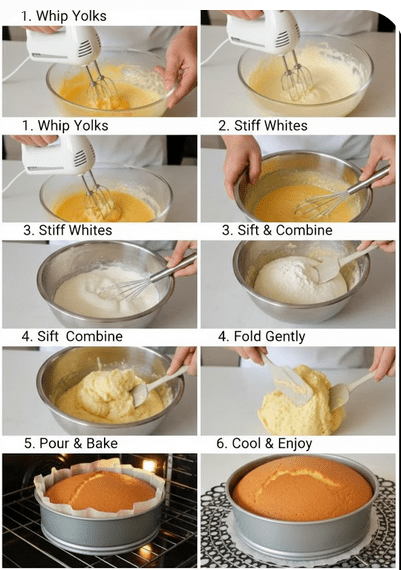
- Whip the Egg Yolks: In a large bowl, beat the egg yolks with $150 \text{ g}$ (3/4 cup) of the sugar until the mixture is pale yellow, thick, and ribbons fall from the whisk (about 5-7 minutes). Beat in the vanilla extract and warm milk.
- Whip the Egg Whites: In a clean, grease-free bowl, beat the egg whites with the pinch of salt until soft peaks form. Gradually add the remaining $50 \text{ g}$ (1/4 cup) of sugar and continue beating until stiff, glossy peaks form.
- Combine Wet and Dry: Sift the flour and baking powder over the yolk mixture. Gently fold it in with a spatula until just combined. Do not overmix! 🚫
- Fold in the Whites: Gently take about a third of the egg white mixture and fold it into the batter to lighten it. Then, add the rest of the egg whites and fold them in carefully using an under-and-over motion until the mixture is uniform and airy. Work quickly and gently to avoid deflating the air.
- Bake: Pour the batter into the prepared cake pan. Bake for 30–35 minutes, or until the cake is golden brown, springy to the touch, and a skewer inserted into the center comes out clean.
- Cool: Let the cake cool in the pan for 10-15 minutes before inverting it onto a wire rack. Carefully peel off the parchment paper and let it cool completely before slicing or frosting. 😌
Troubleshooting Your Sponge Cake
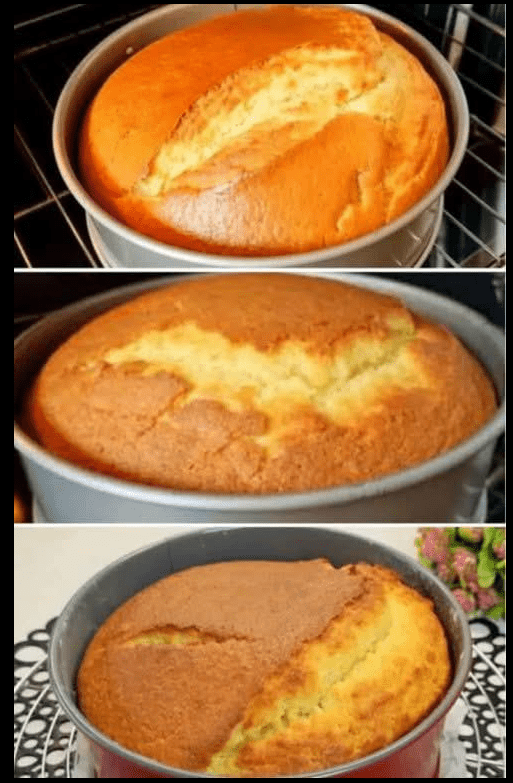
Achieving that perfect sponge takes a little practice. The most common pitfall is a dense, flat cake, which usually happens because the air was knocked out of the batter. Remember to fold, don’t stir when adding the flour and egg whites. Another potential issue is a cake that rises too high, then sinks in the middle (like the images sometimes show) often caused by the oven being too hot or opening the oven door too early. Keep the door closed until the last 10 minutes of baking time! This recipe results in a stable cake that, once cooled, is ideal for slicing into layers.
The lightness of this Vanilla Sponge Cake Recipe makes it incredibly versatile. You can simply dust it with powdered sugar, or you can use it as the base for a magnificent strawberry shortcake or a decadent chocolate layer cake. It’s truly the baker’s best friend. 🍓
Which filling is your all-time favorite to pair with a vanilla sponge cake: a simple jam or a rich buttercream? Let me know!The search for the perfect Vanilla Sponge Cake Recipe often feels like a culinary quest. This foundational cake is a testament to simple elegance—a light, airy base that can star on its own or serve as the perfect canvas for endless fillings and frostings. A truly great sponge cake should be delicate, moist, and bursting with the pure, comforting flavor of vanilla. We’re going to share the secrets to achieving that bakery-quality fluffiness right in your own kitchen, ensuring every slice is simply divine. Get ready to master this essential baking classic! 🎂
The Sweet Science Behind a Classic Sponge
Before diving into the mixing bowl, it helps to understand what makes a sponge cake a sponge. Unlike denser butter cakes, a traditional sponge relies heavily on whipped eggs to incorporate air, which is the sole leavening agent (or works alongside a small amount of baking powder). This trapped air expands during baking, giving the cake its signature light and springy texture. Our specific Vanilla Sponge Cake Recipe uses the creaming method for the yolks with sugar, and then gently folds in stiffly beaten egg whites—a technique that ensures maximum aeration and a stable batter. The result is a cake that is beautifully tall, tender, and evenly textured, with a slight, golden crust. It’s perfect for trifles, layer cakes, or just a simple dusting of powdered sugar.
Essential Ingredients and Preparation Tips
Success in sponge cake baking hinges on the quality and temperature of your ingredients, as well as meticulous preparation.
- Eggs: Use large eggs at room temperature. Cold eggs will not whip up to the required volume. Separate the whites and yolks carefully; any trace of fat in the whites will prevent them from reaching stiff peaks.
- Flour: All-purpose flour is fine, but sifting it (and any baking powder) at least twice is crucial. This aerates the flour, prevents lumps, and makes it easier to fold into the delicate egg mixture without deflating the batter.
- Vanilla: Use a good quality pure vanilla extract—the flavor really shines through in a cake this simple.
- Equipment: A stand mixer or a hand mixer is highly recommended for whipping the eggs. For best results, use a standard 9-inch round cake pan (about 23 cm), greased and lined with parchment paper on the bottom.
Fact Check: Historical records indicate that the sponge cake dates back to the mid-17th century, where it was one of the earliest cakes made without added chemical leavening agents, relying entirely on the eggs for its lift.
Step-by-Step Vanilla Sponge Cake Recipe
Follow these steps precisely for a magnificent, foolproof sponge cake.
Ingredients
- 4 large eggs, separated, at room temperature
- $200 \text{ g}$ (1 cup) granulated sugar, divided
- $180 \text{ g}$ (1 1/2 cups) all-purpose flour, sifted
- 1 teaspoon baking powder
- $60 \text{ ml}$ (1/4 cup) whole milk, warmed
- 1 teaspoon pure vanilla extract
- A pinch of salt
Method
- Preheat and Prepare: Preheat your oven to $180^\circ\text{C}$ ($350^\circ\text{F}$). Grease and line the bottom of your 9-inch cake pan with parchment paper.
- Whip the Egg Yolks: In a large bowl, beat the egg yolks with $150 \text{ g}$ (3/4 cup) of the sugar until the mixture is pale yellow, thick, and ribbons fall from the whisk (about 5-7 minutes). Beat in the vanilla extract and warm milk.
- Whip the Egg Whites: In a clean, grease-free bowl, beat the egg whites with the pinch of salt until soft peaks form. Gradually add the remaining $50 \text{ g}$ (1/4 cup) of sugar and continue beating until stiff, glossy peaks form.
- Combine Wet and Dry: Sift the flour and baking powder over the yolk mixture. Gently fold it in with a spatula until just combined. Do not overmix! 🚫
- Fold in the Whites: Gently take about a third of the egg white mixture and fold it into the batter to lighten it. Then, add the rest of the egg whites and fold them in carefully using an under-and-over motion until the mixture is uniform and airy. Work quickly and gently to avoid deflating the air.
- Bake: Pour the batter into the prepared cake pan. Bake for 30–35 minutes, or until the cake is golden brown, springy to the touch, and a skewer inserted into the center comes out clean.
- Cool: Let the cake cool in the pan for 10-15 minutes before inverting it onto a wire rack. Carefully peel off the parchment paper and let it cool completely before slicing or frosting. 😌
Troubleshooting Your Sponge Cake
Achieving that perfect sponge takes a little practice. The most common pitfall is a dense, flat cake, which usually happens because the air was knocked out of the batter. Remember to fold, don’t stir when adding the flour and egg whites. Another potential issue is a cake that rises too high, then sinks in the middle (like the images sometimes show) often caused by the oven being too hot or opening the oven door too early. Keep the door closed until the last 10 minutes of baking time! This recipe results in a stable cake that, once cooled, is ideal for slicing into layers.
The lightness of this Vanilla Sponge Cake Recipe makes it incredibly versatile. You can simply dust it with powdered sugar, or you can use it as the base for a magnificent strawberry shortcake or a decadent chocolate layer cake. It’s truly the baker’s best friend. 🍓
Which filling is your all-time favorite to pair with a vanilla sponge cake: a simple jam or a rich buttercream? Let me know!
