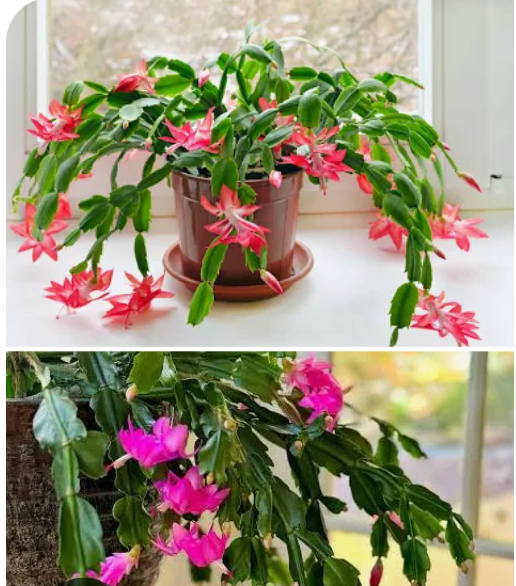
There’s nothing quite as cheerful during the bleak winter months as a Christmas Cactus (Schlumbergera) bursting with vibrant, bell-shaped blooms. You’ve seen those magnificent, cascade-like displays of pink, red, or white, and you might be wondering: what’s the secret to getting my cactus to bloom just like that, year after year?
The answer isn’t a complex fertilizer or a horticultural degree. It often boils down to mimicking the plant’s natural, specific environmental cues—and you can find the tools to do it right in your own kitchen!
Table of Contents
🌵 Understanding Your Christmas Cactus: More Than Just a Desert Dweller
Before we reveal the simple kitchen trick, it’s crucial to understand what a Christmas Cactus really is. Contrary to its name, this plant isn’t from the arid deserts. It’s an epiphytic cactus, native to the coastal mountains of southeastern Brazil, where it lives in the forks of trees, enjoying high humidity and dappled light.
This background tells us two key things for reblooming:
- It needs different care than a typical desert cactus.
- It uses the shorter, cooler days of the late fall to trigger bud formation.
This trigger period is called vernalization, and it’s where your kitchen comes into play!
💡 The Simple Kitchen Trick: The “Dark Rest” Method
The single most effective and easiest way to force your Christmas Cactus into bloom is by using a Dark Rest Period. This involves two interconnected factors: Temperature and Light. Your kitchen, or a part of it, can be the perfect setting.
🌡️ The Temperature Cue
As the days shorten, the natural habitat cools down. Your Christmas Cactus needs this drop in temperature to signal that it’s time to start producing buds instead of new green growth.
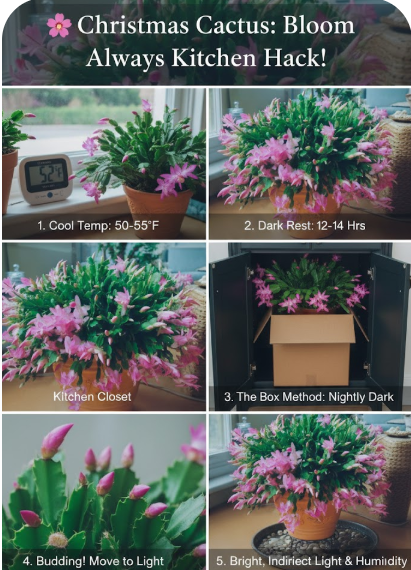
- The Target: The ideal temperature range to encourage blooming is between $50^{\circ}\text{F}$ and $55^{\circ}\text{F}$ ($10^{\circ}\text{C}$ and $13^{\circ}\text{C}$).
- The Kitchen Spot: Think about the naturally cooler spots in your house. A draft-free kitchen windowsill (especially if you live in an older home), a cool mudroom adjacent to the kitchen, or even a spare laundry room can work wonders. Avoid placing it near heat vents or a constantly running oven.
🌑 The Light Cue
This is the most critical part, and where the “kitchen storage” element comes in handy. Christmas Cacti are short-day plants. They must experience 12 to 14 hours of uninterrupted darkness every 24 hours to set flower buds. Even a brief flash of light from a passing car headlight, a porch light, or your smartphone screen can disrupt the process.
📦 Hiding Your Cactus: The Simple Kitchen Solution
The key to achieving perfect, uninterrupted darkness is a common household item: The Cardboard Box.
- Preparation (Starting Mid-September to Early November): Stop fertilizing your plant about a month before you start this process. Slightly reduce watering, but don’t let the plant completely dry out.
- The “Kitchen Closet” Treatment: Every evening, at the same time, place your Christmas Cactus inside a large, light-proof cardboard box. You can store this box in a rarely used kitchen cabinet, a pantry, or a cool utility closet near the kitchen.
- The Schedule: Give the plant a minimum of 12 hours of total darkness—14 hours is even better. For example, if you bring it out onto the kitchen counter at 7:00 AM, it needs to go back into the box by 5:00 PM.
- Duration: Continue this routine for four to six weeks, or until you see small flower buds begin to form on the ends of the leaf segments.
💧 Post-Budding Care: Nurturing the Blooms
Once you see those tiny, rice-grain-sized buds appear, the dark rest period is over. It’s time to transition the plant to its holiday display spot!
🛋️ Finding the Perfect Display Location
Move the cactus to a slightly warmer location that receives bright, indirect light (like a spot a few feet away from a sunny window).
🚧 Critical Rule: Avoid Moving the Plant!
Do not rotate or move the pot once the buds are set. Christmas Cacti are notoriously fickle and will often drop their precious buds if they are moved or rotated to face a different light source. Find its final resting spot and leave it there until the blooms are finished.
🚿 Adjusting the Watering Schedule
Now is the time to increase watering slightly. Keep the soil consistently, lightly moist. Wilting segments usually indicate it’s too dry, while soft, mushy segments mean it’s too wet. Remember, it loves humidity! Placing a shallow tray of pebbles and water beneath the pot (making sure the pot isn’t sitting directly in the water) can help replicate its tropical home.
🎁 Enjoying the Fruits of Your Labor
By using a simple kitchen box and taking advantage of naturally cooler parts of your home, you are replicating the environmental signals that tell your Christmas Cactus it’s time to bloom. It’s a natural, easy, and highly effective way to guarantee a spectacular display, turning your holiday season green and pink! Happy blooming! 🌸
Tags: Christmas Cactus