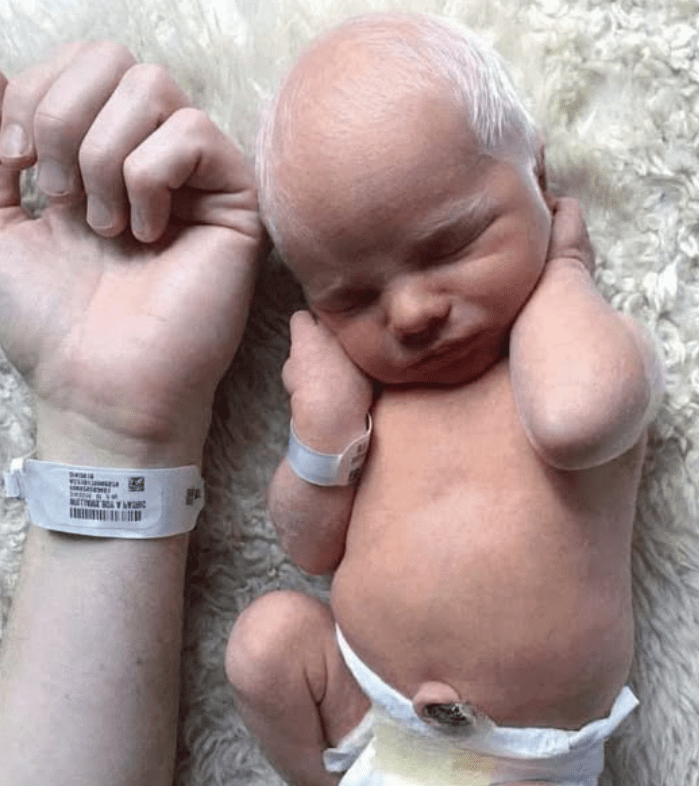
What started as a mother’s wonder at her newborn’s striking appearance would soon transform into a powerful story of resilience, acceptance, and unconditional love.
Patricia will never forget the moment she first laid eyes on her son. In the delivery room’s harsh fluorescent light, something stopped her breath—not from fear, but from sheer astonishment. The infant cradled in her arms possessed hair as white as fresh snow and eyes of the most piercing, crystalline blue she had ever seen. Her son, Redd, looked unlike any baby she had encountered before.
Yet in that initial moment of wonder, Patricia couldn’t have imagined the challenging path that lay ahead for her family—or the profound lessons they would learn along the way.
Table of Contents
The Mystery Unfolds
In those first weeks of 2012, Patricia and her husband convinced themselves that their son’s unusual appearance was simply a genetic quirk, perhaps inherited from some distant ancestor. The white hair was striking, yes, but many babies are born with surprising features that normalize over time.
Then came the movements.
Redd’s eyes began tracking in ways that seemed… wrong. Involuntary, rapid movements that no amount of soothing could calm. The parents exchanged worried glances across the nursery. Something deeper was happening here, something they didn’t understand.
The pediatric appointments that followed brought a mixture of relief and anxiety. After careful examination and testing, doctors delivered a diagnosis that would reshape their world: Redd had oculocutaneous albinism type 1, or OCA1—a rare genetic condition affecting approximately one in every 17,000 people worldwide.
The condition explained everything: the snow-white hair, the translucent blue eyes, the unusual eye movements. But it also introduced a new reality—one that would require complete adaptation of their daily lives.
A Life Transformed
What many people fail to understand about albinism is that it extends far beyond appearance. The condition carries serious medical implications that Patricia and her husband had to master quickly.
The sun, that life-giving star that most children play under without a second thought, became something to strategically avoid. Redd’s skin possessed virtually no melanin—the pigment that protects against ultraviolet radiation. Even brief exposure could cause severe burns. His vision, too, was compromised, making bright light painful and detailed sight difficult.
Their home transformed. Bottles of SPF 50+ sunscreen appeared in every room. Wide-brimmed hats became standard attire before stepping outside. Specialized sunglasses became as essential as shoes. Every outing required military-level planning: What time of day? How much shade? How long would they be exposed?
But the physical challenges, demanding as they were, paled in comparison to the invisible wounds.
The Cruelest Cut
School hallways. Playgrounds. Grocery store aisles. Anywhere children gathered, Redd faced the same reaction: stares, whispers, pointed fingers. Some children were merely curious, their innocence making their questions direct but not malicious. Others were cruel in the way only children can be, their lack of understanding manifesting as mockery.
“Why does he look like a ghost?”
“Is his hair real?”
“Is he sick?”
The questions came daily, relentless as ocean waves. For a young boy trying to find his place in the world, each comment felt like a small rejection, a reminder that he didn’t quite fit the mold of “normal.”
This was where Patricia and her husband’s true strength emerged. They became more than parents—they became Redd’s advocates, his educators, his unwavering support system. They taught him that being different wasn’t being less. They showed him that his condition was simply a characteristic, not a definition of his worth.
But something else was brewing—something that would test their resilience even further.
Lightning Strikes Twice
Just when the family had established their new normal, Patricia discovered she was pregnant again. The joy was immediate, but so was a gnawing question: What were the odds?
Albinism is recessive, requiring both parents to carry the gene. With one affected child, they knew both parents were carriers. Basic genetics suggested a 25% chance their second child would also have the condition.
When Rockwell was born, the delivery room fell into a familiar hush. Another head of brilliant white hair. Another pair of impossibly blue eyes.
Against the odds, their second son also had albinism.
The statistical improbability was staggering, but Patricia felt something unexpected: not dismay, but a strange sense of rightness. Redd would have a brother who truly understood. They would face the world’s stares together, a united front of two extraordinary boys who just happened to look different.
The Present Day: A Story of Triumph
Today, both boys are thriving. The journey hasn’t been easy—medical appointments continue, sun protection remains crucial, and curious stares still follow them in public spaces. But something fundamental has shifted.
Redd carries himself with quiet confidence, his early experiences with difference having forged resilience rather than breaking his spirit. He’s learned to educate rather than withdraw, to respond to curiosity with patient explanation. His brother Rockwell, following in his footsteps, benefits from the path already carved.
Patricia shares their story publicly now, posting updates that radiate with joy and health. The family has become informal ambassadors for albinism awareness, helping others understand that different doesn’t mean diminished.
The boys’ brilliant white hair catches sunlight like a beacon—no longer a mark of something to hide, but a celebration of their unique journey. Their radiant smiles in family photos tell a story more powerful than any diagnosis: this is a family that chose love over fear, education over ignorance, and celebration over shame.
What Lies Beneath
The story of Redd and Rockwell reminds us that our initial reactions to difference often mask a deeper truth: that every unusual characteristic carries with it both challenges and unexpected gifts. The same condition that made their early years difficult also gave them perspective, empathy, and strength that many never develop.
Their parents’ unwavering support transformed what could have been a story of struggle into one of triumph—proof that acceptance begins at home, and that love remains the most powerful tool for navigating a world that doesn’t always understand what it sees.
As for what the future holds for these remarkable boys, one thing seems certain: they will continue to shine, in every sense of the word.
